

Transformer Manufacturers in India:
An Industrial Buyer's Guide for 2026
If you are procuring a transformer for a factory, power plant, substation, or large infrastructure project, you already know that the manufacturer matters as much as the specification. A transformer is a 25–30-year asset. A poor procurement decision — whether on specification, testing, or supplier reliability — will compound over decades.
This guide is written for procurement managers, electrical engineers, and EPC project teams. It provides a structured view of India's leading transformer manufacturers, a practical evaluation framework, and a comparison of the two most commonly specified transformer types — dry and oil-cooled — so you can make an informed decision before issuing your RFQ.
KLR Transformers is a Visakhapatnam-based manufacturer specialising in custom-engineered transformers for industrial, solar, and infrastructure applications. Products are manufactured to IS 2026 and IEC 60076 standards, covering ratings from 25 kVA to 20 MVA+.
Contact our engineering team for a technical consultation: enquiries@klrtransformers.com
1. Transformer Manufacturers in India: At a Glance
The table below provides a reference comparison of leading transformer manufacturers active in India's industrial and infrastructure markets. The list is not exhaustive — India has over 400 registered transformer manufacturers — but covers the suppliers most frequently encountered in large-scale procurement.
| Manufacturer | Headquarters | Primary Focus | Scale | Certifications |
|---|---|---|---|---|
| KLR Transformers | Visakhapatnam, AP | Industrial, Solar, Custom | SME–Large | IS 2026, IEC 60076, ISO |
| ABB India | Bengaluru, KA | Power & Distribution | Large–Enterprise | IEC, IS, ISO |
| Crompton Greaves (CG) | Mumbai, MH | Distribution & Power | Large–Enterprise | IS, IEC, ISO |
| Bharat Bijlee | Mumbai, MH | Industrial & Distribution | Mid–Large | IS 2026, ISO |
| Schneider Electric India | Bengaluru, KA | Commercial, Automation | Large–Enterprise | IEC, ISO, CE |
| Siemens India | Mumbai, MH | Power, HV Transmission | Enterprise | IEC, ISO, CE |
| Voltamp Transformers | Vadodara, GJ | Distribution, Renewables | Mid–Large | IS, ISO, CPRI tested |
| Transformers & Rectifiers (T&R) | Ahmedabad, GJ | Custom Industrial, EHV | Mid–Large | IS 2026, IEC 60076 |
| Kirloskar Electric | Bengaluru, KA | Dry-type, Industrial | Mid–Large | IS, ISO |
| CG Power & Industrial | Mumbai, MH | Power, HV, Industrial | Large–Enterprise | IS, IEC, ISO |
2. KLR Transformers — Featured Manufacturer Profile
KLR Transformers is featured in depth because this guide is published by KLR — and because we believe buyers deserve more than a two-sentence entry when evaluating a potential supplier. The following profile gives you the information you would normally need to ask for at the RFQ stage.
| Field | Detail |
|---|---|
| Headquarters | Visakhapatnam, Andhra Pradesh |
| Manufacturing Standard | IS 2026 / IEC 60076 |
| Certifications | ISO, BIS Licence |
| Rating Range | 25 kVA to 20 MVA+ |
| Testing | CPRI-tested; type test and routine test reports available on request |
| Delivery | South India standard; PAN India on request; export capability for Gulf and Southeast Asia |
What KLR Manufactures
- Power transformers — step-up and step-down for industrial, infrastructure, and renewable energy applications
- Distribution transformers — 11 kV and 33 kV class for utilities and captive power systems
- Inverter duty transformers — K-factor rated units for solar, wind, VFD, and BESS applications
- Dry-type transformers — for indoor industrial and commercial installations
- Furnace transformers — for steel, ferro-alloy, and induction heating applications
- Custom-engineered units — non-standard ratings, voltages, or configurations to buyer specification
Where KLR Is the Right Choice
KLR is particularly well-suited to buyers who need:
- Custom or non-standard specifications — ratings, voltage classes, or configurations not available off the shelf from volume manufacturers
- Direct engineering access — buyers who need technical dialogue with the design team, not a commercial intermediary
- Faster turnaround on standard ratings — typical delivery 4–8 weeks for units up to 2 MVA
- Projects in South India — Andhra Pradesh, Telangana, Tamil Nadu, Karnataka — with local service capability
- IS 2026 / IEC 60076 documentation for grid operator interconnection approvals
Share your specification — rating, voltage class, application type, site location — and our engineering team will respond within 48 hours with a technical proposal and indicative pricing.
Email: enquiries@klrtransformers.com | Phone: [Your Number] | Web: [Your Website]
3. Other Major Transformer Manufacturers in India
For completeness, the following profiles summarise the other manufacturers listed in the comparison table. This information is drawn from publicly available sources and is intended as a general reference — contact each manufacturer directly for current product specifications and pricing.
ABB India
ABB India is part of ABB Group, a Swiss multinational with one of the broadest transformer portfolios globally. In India, ABB manufactures power and distribution transformers through its Vadodara facility, serving utilities, large infrastructure, and renewable energy sectors. ABB's strengths lie in high-voltage and extra-high-voltage power transformers. For most industrial buyers below the 10 MVA range, ABB's commercial minimum order requirements and lead times may make a specialist domestic manufacturer a more practical choice.
Crompton Greaves (CG Power & Industrial Solutions)
CG Power is one of India's oldest and most established transformer manufacturers, with manufacturing facilities in Nashik, Bhopal, and Kanjurmarg. CG serves utilities and large industrial clients with a wide range from distribution transformers to EHV units above 400 kV. CG Power is a strong choice for utility-scale power transformers and has a long track record with state electricity boards and grid operators across India.
Bharat Bijlee Limited
Bharat Bijlee, headquartered in Mumbai, manufactures dry-type and oil-cooled transformers for industrial and commercial applications. The company has a particularly strong position in the dry-type segment and is well-regarded for product quality and reliability. Bharat Bijlee tends to focus on standard catalogue products rather than highly customised specifications.
Schneider Electric India
Schneider Electric's transformer offering in India is primarily oriented toward commercial buildings, data centres, and automation-integrated industrial facilities. Schneider's dry-type Cast Resin Transformers (CRT) are widely specified in modern commercial and institutional projects. For heavy industrial or utility-scale applications requiring oil-cooled units, Schneider is less commonly the primary supplier.
Siemens India
Siemens manufactures high-capacity power transformers at its Kalwa facility in Maharashtra, primarily serving the transmission and extra-high-voltage segment. Siemens transformers are specified for large grid projects, major EPC contracts, and export assignments. For most industrial buyers below 20 MVA, Siemens's commercial framework and minimum project thresholds position them outside the practical procurement range.
Voltamp Transformers
Voltamp is a Vadodara-based manufacturer with a strong distribution transformer product line and a growing presence in the renewable energy segment. Voltamp is noted for competitive pricing on standard ratings and reasonable delivery performance. The company has ISO certification and an established track record with EPC contractors and private developers across western and southern India.
Transformers & Rectifiers India (T&R)
T&R, based in Ahmedabad, is a specialist manufacturer known for custom and extra-high-voltage transformer solutions. T&R has an unusually broad rating capability for an Indian manufacturer and has supplied units for HVDC, reactor, and furnace transformer applications. For buyers requiring highly customised or technically complex units, T&R is among the strongest domestic options alongside KLR.
Kirloskar Electric Company
Kirloskar Electric manufactures dry-type and oil-cooled transformers from its Bengaluru facility. The company is part of the Kirloskar Group and has a long industrial heritage in India. Kirloskar Electric is a reliable mid-market choice for standard industrial specifications, with a reasonable service network across South India.
4. Dry-Type vs. Oil-Cooled Transformers: Which Should You Specify?
The most common specification decision buyers face — beyond manufacturer selection — is whether to specify a dry-type or oil-cooled transformer. The decision is determined primarily by installation location, load size, fire safety requirements, and maintenance infrastructure.
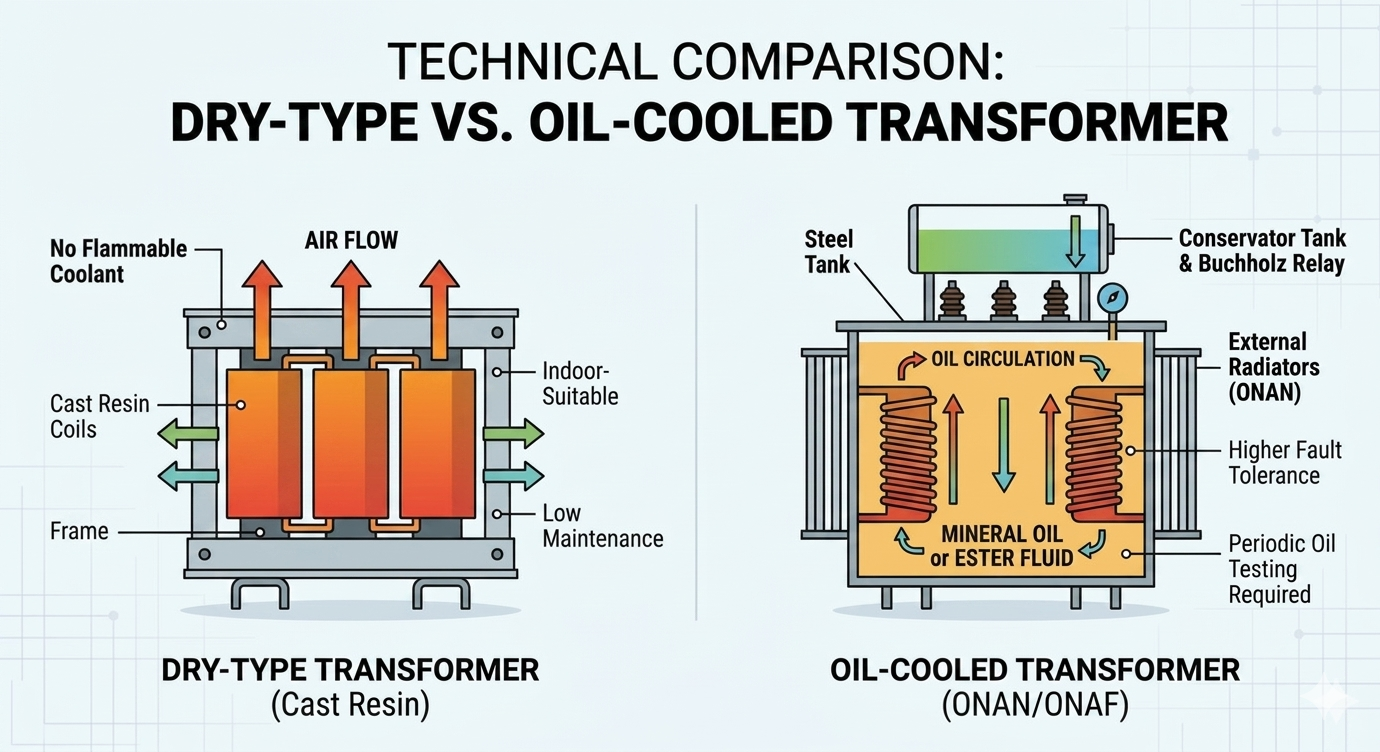
| Criteria | Dry-Type Transformer | Oil-Cooled Transformer |
|---|---|---|
| Installation Location | Indoor — offices, hospitals, data centres, high-rise buildings | Outdoor or purpose-built substations |
| Fire Risk | Low — no flammable coolant; preferred in occupied buildings | Higher — mineral oil is flammable; requires bunding and fire suppression |
| Capacity Range | Up to ~10 MVA (standard); custom higher ratings available | 25 kVA to 315 MVA and above |
| Cooling Medium | Air (natural convection or forced air) | Mineral oil or biodegradable ester fluid |
| Maintenance Requirement | Low — no oil sampling, no Buchholz relay, no conservator tank | Moderate — oil condition monitoring, dehydration breather, periodic oil testing |
| Efficiency at Full Load | Slightly lower at very high ratings | Higher efficiency at large ratings due to superior thermal management |
| Capital Cost | Higher per kVA at larger ratings | Lower per kVA at ratings above 500 kVA |
| Environmental Suitability | Good for clean indoor environments | Suitable for all outdoor industrial conditions; IP-rated enclosures available |
| Applicable Standard | IS 11171, IEC 60076-11 | IS 2026, IEC 60076 |
KLR manufactures both dry-type and oil-cooled transformers. If you are uncertain which type suits your application, share your site conditions and load profile with our team and we will recommend the appropriate specification — including whether a cast resin dry-type unit or a hermetically sealed oil-cooled unit better fits your environment.
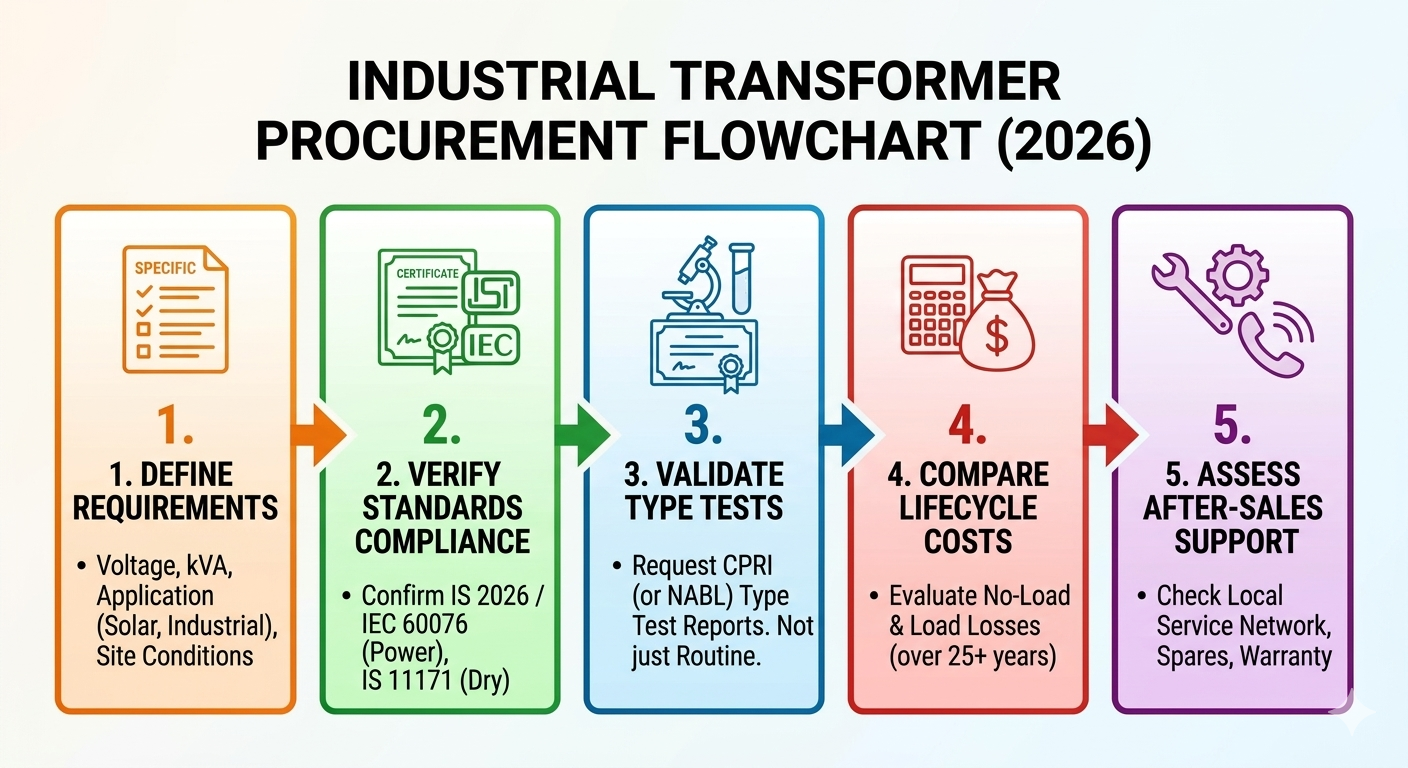
5. How to Evaluate a Transformer Manufacturer: A Procurement Checklist
The following criteria should be applied when evaluating any transformer manufacturer for a serious procurement decision. Do not rely on marketing materials alone — request documentation for each item.
| Evaluation Criterion | What to Check | Why It Matters |
|---|---|---|
| Applicable Standard Compliance | IS 2026 (Parts 1–5) and/or IEC 60076 certification; BIS licence for distribution transformers | Ensures the unit meets statutory and grid interconnection requirements in India |
| Type Test vs. Routine Test | Confirm that type test reports (CPRI or NABL lab) are available, not just routine test certificates | Type tests validate design; routine tests only verify individual units meet production spec |
| Short-Circuit Withstand Rating | Request test evidence or calculation to IEC 60076-5 | Transformers not rated for fault current will fail catastrophically during grid faults |
| Vector Group | Dyn11 is standard for distribution; confirm with the grid operator for protection coordination | A wrong vector group causes relay misoperation and protection system failures |
| Impedance Voltage (%Z) | Typically 4–6% for distribution; higher for industrial short-circuit limitation | Impedance affects fault current levels and voltage regulation under load |
| No-Load and Load Losses | Request guaranteed loss values; compare to BEE star rating benchmarks | Transformer losses are a 25-year lifecycle cost — often larger than the purchase price |
| Tap Changer Type | Off-circuit (OCTC) vs. on-load (OLTC) — specify based on voltage regulation need | OLTC required for sites with significant load variation; OCTC for stable supply points |
| Cooling Class Designation | ONAN / ONAF / OFAF per IEC 60076 | Determines operating temperature and overload capability in site ambient conditions |
| After-Sales and Spare Parts | Confirm local service presence, spares availability, and warranty terms | A transformer purchased from a distant supplier with no local service will cost more to maintain |
6. Applicable Standards for Transformer Procurement in India
All transformer procurement in India should reference the following standards. Include these in your RFQ and purchase order terms:
IS 2026 (Parts 1–5) — Power Transformers
The primary Indian standard for power transformers, harmonised with IEC 60076. Covers general requirements, temperature rise, insulation levels, tapping and connections, and the ability to withstand short circuit. Mandatory for grid-connected transformers above 25 kVA.
IS 11171 — Dry-Type Power Transformers
Governs dry-type transformer design, testing, and performance. Relevant for all indoor dry-type specifications. Harmonised with IEC 60076-11.
IEC 60076 (Parts 1–16)
The international standard series for power transformers. Indian manufacturers supplying export projects, or projects specifying IEC compliance for international lenders or grid operators, must comply with relevant IEC 60076 parts.
BIS Licence (Bureau of Indian Standards)
Distribution transformers in India require a BIS licence under IS 1180. This is a statutory requirement for transformers supplied to state electricity boards and public utilities. Always verify the manufacturer holds a current BIS licence for the rating range being procured.
IEEE C57.110 — Non-Sinusoidal Load Currents (K-Factor)
Applicable for inverter duty transformers. Specifies the methodology for calculating the K-factor and determining transformer capability under harmonic loading conditions.
Frequently Asked Questions
There is no single answer — the best manufacturer for your project depends on rating, application, location, lead time, and customisation needs. For utility-scale transmission projects above 100 MVA, Siemens, ABB, or CG Power are the established choices. For industrial applications in the 100 kVA to 10 MVA range — particularly for solar, VFD, or custom process applications — specialist domestic manufacturers like KLR Transformers offer direct engineering access, faster delivery, and comparable or superior product quality.
IS 2026 is the Indian National Standard for power transformers, published by BIS (Bureau of Indian Standards). IEC 60076 is the equivalent international standard, published by the International Electrotechnical Commission. IS 2026 is harmonised with IEC 60076, meaning they are substantially identical in technical requirements. For most domestic Indian projects, IS 2026 compliance is sufficient. For international projects or projects with foreign lender requirements, IEC 60076 compliance is typically specified.
CPRI (Central Power Research Institute) is India's premier independent testing authority for electrical equipment. A CPRI type test report certifies that a transformer design has been tested to the relevant IS/IEC standard by an independent body — not just by the manufacturer. This is the gold standard for transformer quality assurance in India. Buyers should always request CPRI or equivalent NABL-accredited test reports for transformers above 1 MVA.
Lead times vary significantly by rating, complexity, and manufacturer capacity. As a general guide: standard distribution transformers (up to 2,000 kVA) typically ship in 4–8 weeks; medium power transformers (2–10 MVA) in 8–14 weeks; large power transformers above 10 MVA may require 16–24 weeks or longer. Custom-engineered units at any rating add 2–4 weeks for design finalisation. Always build a buffer into your project schedule and confirm lead time in writing before signing a purchase order.
Yes. KLR supplies to projects across South India as standard, with established logistics to Telangana, Tamil Nadu, and Karnataka. For projects elsewhere in India, our team can confirm delivery terms and lead times based on your project location. We also have export capability for projects in the Gulf region and Southeast Asia.
Ready to Discuss Your Transformer Requirement?
KLR Transformers works directly with EPC firms, utilities, factories, and infrastructure developers. Share your specification, and we'll provide a technical consultation, product recommendation, and indicative pricing — typically within 48 hours.
Request a Technical Consultation → enquiries@klrtransformers.com